

When you’re drowning in debt and thinking about bankruptcy, you want to understand exactly what will happen to every obligation you have — especially when it comes to your home. If you have a home equity loan or a home equity line of credit (HELOC), you might wonder: will bankruptcy make it disappear?
Here’s the truth: bankruptcy can eliminate your personal obligation to pay a home equity loan, but that doesn’t mean the debt goes away completely. The loan will still exist as a lien against your home, and if you want to keep your house, you’ll need to keep making those payments — even if the lender stops sending you statements.
This can feel confusing, but understanding how it works gives you control over your situation. Let’s walk through what really happens to your home equity loan when you file Chapter 7 or Chapter 13 bankruptcy in Minnesota or North Dakota.
Understanding the Difference: Personal Liability vs. Property Liens
Before we go further, you need to understand one key concept: there are two parts to most secured debts like home equity loans.
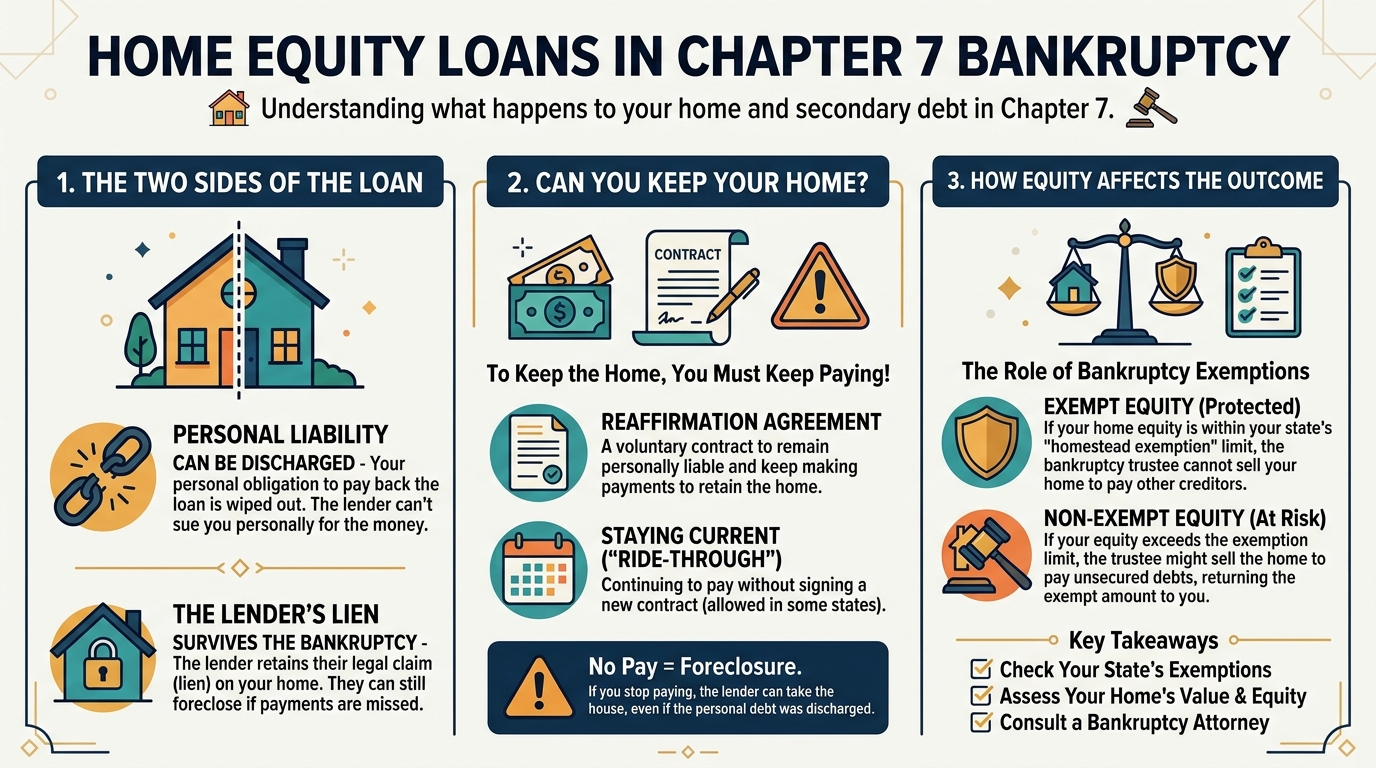
Personal liability means you personally owe the money. If you stop paying, the lender can sue you, get a judgment, garnish your wages, or take money from your bank account.
The lien means the lender has a legal claim against your property. If you stop paying, they can foreclose and take your house to satisfy the debt — but they can’t come after you personally for any remaining balance after the foreclosure sale.
When you file bankruptcy, you can eliminate your personal liability for the home equity loan. That’s the part that shows up on your credit report and allows collectors to sue you. But the lien stays attached to your home until the loan is paid off or the property is sold.
Think of it this way: bankruptcy cuts the rope tying you to the debt, but it doesn’t remove the anchor attached to your house.
What Happens in Chapter 7 Bankruptcy
In a Chapter 7 bankruptcy, unsecured debts like credit cards and medical bills are wiped out completely — you don’t owe them anymore, period. But home equity loans are secured by your property, which changes everything.
When you file Chapter 7, your personal obligation to repay the home equity loan is discharged. The lender can’t sue you, can’t call you, and can’t report missed payments to the credit bureaus after your bankruptcy case closes.
But here’s what doesn’t change:
- The lien remains on your home
- If you stop paying, the lender can still foreclose
- The interest rate stays the same
- The monthly payment amount doesn’t change
- You’re still expected to make every payment on time
Sometimes after your bankruptcy is over, the lender stops sending you monthly statements. This happens because technically, you don’t personally owe them anymore — so they’re not required to send bills. But that doesn’t mean you can stop paying. The lien is still there, quietly waiting.
If you want to keep your home, you need to keep making those payments exactly as you did before bankruptcy, even if you never hear from the lender again. Many people set up automatic payments to make sure nothing falls through the cracks.
What Happens in Chapter 13 Bankruptcy
Chapter 13 works differently. Instead of wiping out your debts immediately, you enter a 3-to-5-year repayment plan that reorganizes what you owe and lets you catch up on missed payments while keeping your property.
If you’ve fallen behind on your home equity loan — or even your first mortgage — Chapter 13 bankruptcy can stop foreclosure and give you time to get current again. Your regular monthly payment on the home equity loan continues outside the plan, and any past-due amounts are spread out over the life of your Chapter 13 case.
Just like in Chapter 7, your personal liability for the home equity loan is discharged when you complete your plan. But the lien remains, and you still have to make your regular monthly payments to keep your home.
The terms of your loan — the interest rate, the payment schedule, the balance — don’t change in Chapter 13. What changes is that you get breathing room to catch up and protection from foreclosure while you’re in the plan.
Why the Loan Disappears From Your Credit Report (But Not From Your Life)
After your bankruptcy is complete, you’ll notice that your home equity loan no longer shows up on your credit report. That’s because the credit bureaus are no longer allowed to report a debt you don’t personally owe.
This is good news for rebuilding your credit — the debt isn’t dragging down your score anymore. But it can also be misleading. Just because the loan isn’t on your credit report doesn’t mean it’s gone.
The lien is still attached to your home. If you sell the house, the lender gets paid from the sale proceeds. If you stop making payments, they can foreclose. The loan is still real, still active, and still secured by your property.
What If You Stop Paying After Bankruptcy?
Let’s say you file bankruptcy, your personal liability is discharged, and you decide to stop making payments on the home equity loan. What happens?
The lender can’t sue you. They can’t garnish your wages. They can’t report the missed payments to your credit. But they can foreclose on your home.
In Minnesota and North Dakota, foreclosure is a legal process that lets the lender take your house, sell it, and use the proceeds to pay off the loan. If you’ve discharged your personal liability in bankruptcy, the lender can’t come after you for any remaining balance after the sale — but you’ll still lose your home.
If keeping your home is important to you, you have to keep paying the home equity loan, even after bankruptcy. There’s no way around it.
When Does It Make Sense to Keep Paying?
Not everyone wants to keep their home after bankruptcy, and that’s okay. If your house is worth less than what you owe, or if the payments are unaffordable, you might choose to surrender the property and walk away without personal liability.
But if you want to stay in your home, paying the home equity loan is non-negotiable — even if:
- The lender stops sending statements
- The loan doesn’t appear on your credit report
- You never hear from the lender again
Keep records of every payment you make. If the lender isn’t sending statements, contact them regularly to get payoff balances and confirm your account is current. Protect yourself by documenting everything.
Get Clear Answers Before You File
Bankruptcy is a powerful tool for getting a fresh start, but it works best when you understand exactly what will happen to every debt you have — including secured loans like home equity debt.
At Walker & Walker Law Offices, we’ve been helping families in Minnesota and North Dakota navigate bankruptcy for over 40 years. We’ll walk you through how bankruptcy affects your home, your equity loan, and your financial future — in plain language, with no surprises.
If you’re struggling with debt and want to know your options, we’re here to help. You don’t have to figure this out alone.
Contact Walker & Walker Law Offices today for a free consultation. Let’s talk about your situation and find the path that gives you the fresh start you deserve — with your home protected and your future secure.





